
Villa 27, Al Raddi St., Umm Suqeim 1, Dubai

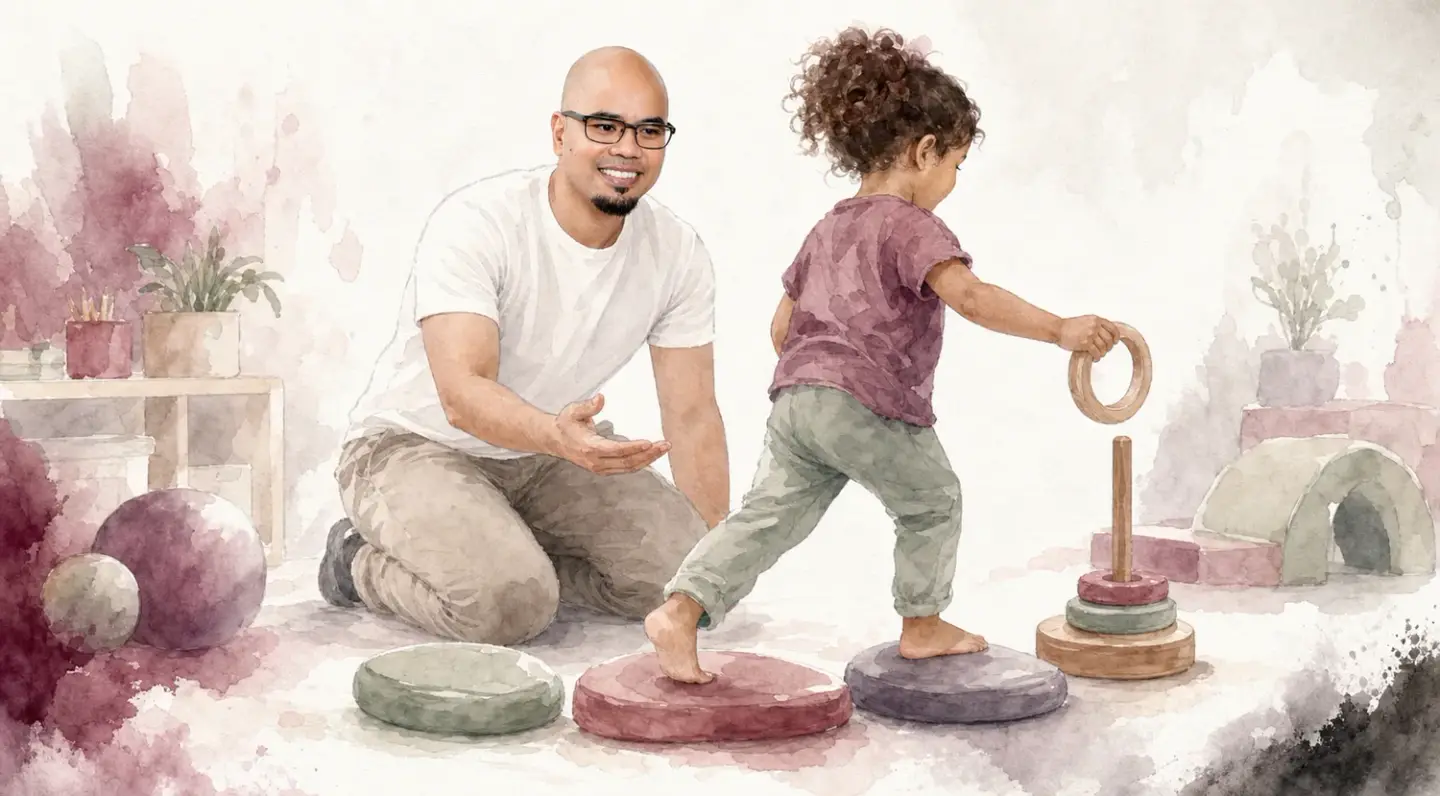
Watercolor scene of an occupational therapist supporting a child through a movement activity

Occupational therapy and participation

Small steps can open a bigger world.

Support for self-care, school, and play, so children can take part as fully as possible in everyday life.

Who this is for

  • Attention and concentration deficit
  • Learning difficulties
  • Developmental coordination disorder or dyspraxia
  • Handwriting challenges or deficits
  • Planning and organization difficulties
  • Delayed or impaired gross or fine motor development
  • Sensory processing disorder (SPD)
  • Traumatic injuries (brain or spinal cord)
  • Autism spectrum disorder and other developmental conditions
  • Neurological disorders and neuromuscular challenges
  • General or specific developmental challenges or delays
  • Multiple sclerosis, cerebral palsy, or other physical challenges

What occupational therapy feels like

A room your senses can rest in.

Our sensory room has bubble tubes, lava lamps, a ball pit, sensory swings, padded areas, and a listening station for calming music. It is not a playroom with mood lighting: each piece is chosen for the kinds of input it gives, in a dose the therapist controls, so a child can find out what their body needs to feel settled and ready.

This page works the same way. The first bands below give a feel for those kinds of input — touch them, watch them, or simply read on.

Touch

Some children seek touch. Some avoid it.

A sequin cushion lets a child decide how much they feel, one stroke at a time: the same movement gives a different texture each way, and nothing happens until they choose to move.

Textures like this meet a child where they are — a first, safe kind of touch for a child who pulls away, and a steady, satisfying one for a child who needs more.

Stroke it. Then stroke it back.
Sight

Slow, predictable movement settles the body.

A bubble tube gives the eyes something to follow and the breathing something to slow down to. Sessions often begin here for a child who arrives wound up, and end here for a child who has worked hard.

The color changes are slow on purpose. Fast, flashing light does the opposite of what we want.

Nothing here flashes, and you can pause it at any time.

Sight and fine motor

Light you can hold.

Fiber-optic strands can be gathered, sorted by color, wrapped around a wrist, or threaded through fingers. A child who will not look at a table task may still follow a point of light across their midline, and may use a pincer grasp to catch a single strand.

That is how a lot of fine-motor work starts: with something the child wants to hold.

Balance — the vestibular sense

Movement is a sense too.

The vestibular system in the inner ear tells the brain where the head is and how it is moving. For some children it is under-responsive, so they spin and crash to feel anything; for others it is over-responsive, so a swing or a slide is frightening.

A sensory swing lets the therapist give exactly the movement a child can use — linear or rotary, slow or brisk, for as long as it organizes rather than overwhelms. It is prescribed, not free play.

Shared territory with speech and language therapy: the inner ear does both balance and hearing, and we work together when a child has difficulties with both.

Body sense — proprioception

Deep pressure tells the body where it is.

Receptors in the muscles and joints report where each limb is and how hard it is working. Children who are unsure of that signal lean, bump, squeeze too hard or too softly, and tire quickly at a desk.

Heavy work — pushing, pulling, carrying, climbing — and deep-pressure input such as firm brushing, joint compressions, or a weighted lap pad are among the ways an occupational therapist may add body-sense input; whether any of them suits a child is decided after assessment. If a brushing program is used, it is taught to parents step by step and followed on a schedule; it is never improvised.

Firm and slow is the point.

The eight senses

Most people can name five. We work with eight.

Every child has a sensory profile — which inputs they seek, which they avoid, which they notice less, and how quickly they settle. An occupational therapist maps that profile and then changes the environment, the task, or the child’s own strategies so that everyday life fits better.

  1. Sight

    Light, color, movement, and clutter — and how much of it a child can take in before they stop being able to think.

    Seeking: Loves lights, spinning objects, and screens

    Avoiding: Squints, looks away, covers the eyes in bright rooms

  2. Hearing

    Volume and pitch, but also the ability to pick a voice out of a noisy room.

    Seeking: Makes noise, hums, turns everything up

    Avoiding: Covers the ears, melts down at hand dryers and assemblies

  3. Touch

    Texture, temperature, light touch, and firm touch are picked up by different kinds of receptors in the skin.

    Seeking: Touches everything and everyone

    Avoiding: Hates tags, seams, hair washing, and messy play

  4. Taste

    Flavor, and the texture and temperature of food in the mouth.

    Seeking: Chews sleeves, licks things, craves strong flavors

    Avoiding: A very short list of accepted foods

  5. Smell

    A sense that can set off strong reactions, and the one adults forget to check.

    Seeking: Smells people, food, and objects

    Avoiding: Gags or refuses rooms with a smell

  6. Balance (vestibular)

    Where the head is and how it is moving; the base for posture, eye control, and feeling safe on the move.

    Seeking: Spins, swings, hangs upside down

    Avoiding: Fears elevators, escalators, and having the feet off the ground

  7. Body sense (proprioception)

    Where each limb is and how much force it is using — the sense behind handwriting pressure and gentle hugs.

    Seeking: Crashes, squeezes, jumps, chews

    Avoiding: Rarely a problem in itself — many children find deep pressure calming

  8. Inner sense (interoception)

    Signals from inside the body: hunger, thirst, a full bladder, a racing heart. It underpins toileting and recognizing one’s own emotions.

    Notices less: Misses hunger and bathroom cues; feelings arrive as a surprise

Fine motor and handwriting

Handwriting is a motor skill before it is a school skill.

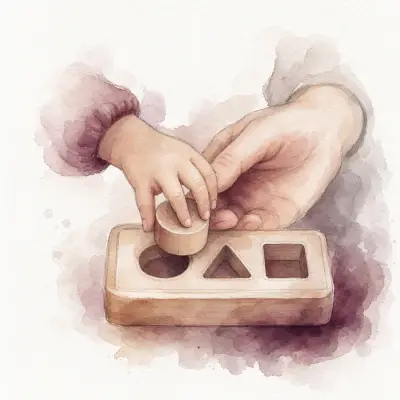
Before a pencil there is shoulder stability, a wrist that can extend, fingers that can work separately from the hand, and two hands that can do different jobs at once. Shape sorters, tweezers, dough, threading, and climbing build those foundations.

When writing itself is the barrier — slow, painful, illegible, or avoided altogether — an occupational therapist looks at grasp, pressure, letter formation, and the sensory and attention load of the task, and works with the school on what to change.

Watercolor illustration of hands using a wooden shape sorter

In detail

What occupational therapy is

Occupational therapy is a profession that uses meaningful and purposeful activity to help people with limitations or impairments take part as fully as possible in the activities of everyday life.

Pediatric occupational therapists help children develop skills in self-care, school, and play, which are a child’s main areas of occupation. In supporting children, they also work indirectly on confidence, self-esteem, social skills, play skills, and general well-being.

Occupational therapy is based on a holistic view of the person and on the unity of body and mind. The aim of therapy is to help thinking, feelings, imagination, and movement work together, so that a child can take part in everyday life alongside other people.

Techniques used

The techniques used are varied and tailored to each person:

  • Sensory integration technique (Jean Ayres)
  • Spontaneous and directed play
  • Motor planning and movement skills training
  • Coordination and balance
  • Handwriting and fine-motor intervention
  • Relaxation and self-regulation strategies

Who would benefit

The occupational therapist works with people of all ages, from birth to adulthood.

What happens next

Call the center and the team will talk you through assessment and next steps.

The team behind this service

The people your family will meet. Everyone works under the center’s clinical leads and shares one plan for your child.

  • Portrait of Santiago Zamora
    Santiago Zamora Occupational Therapist Bachelor’s degree in Occupational Therapy · Certified in sensory integration

WhatsApp is for arranging a conversation — please don’t send medical details or your child’s information there.